
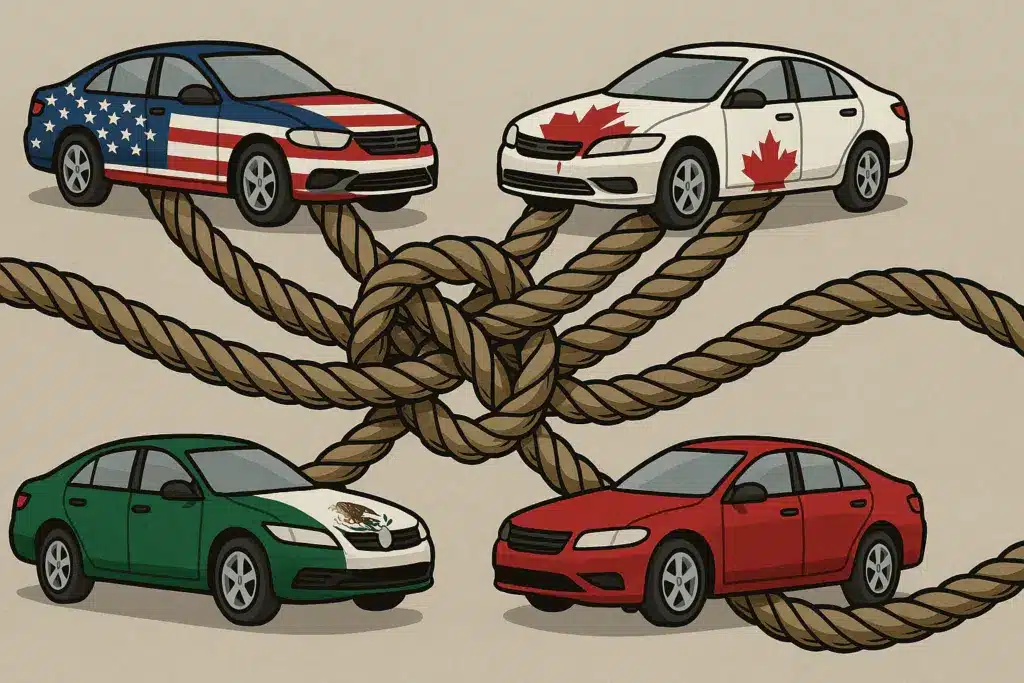
The North American auto supply chain is so tightly woven that a single car can contain parts that crossed the US-Canada or US-Mexico border several times before it was finished. That integration is why untangling it with tariffs is so hard, and it also shapes what you pay when you ship a car between the US and Canada. Since 2025, both countries have taxed vehicles based on where they were built and how much North American content they contain. This guide explains how the supply chain works, why the rules are written the way they are, and what it means for your cross-border shipment.
How integrated is the North American auto industry?
The auto industries of the United States, Canada and Mexico are deeply connected. Since the Canada-US Auto Pact of 1965, and especially after NAFTA took effect in 1994, automakers and suppliers have organized production across all three countries to cut costs and use each one’s strengths. A car assembled in Michigan or Ontario may contain parts that have crossed the border several times. A few examples:
Engine blocks
A Canadian foundry casts the raw block, a plant in the US Midwest machines it and installs pistons and crankshafts, and the finished engine goes into a vehicle at an assembly plant in Mexico.
Wiring harnesses
Wires and connectors made in the US are assembled into harnesses in Mexico, a global center for this labour-intensive work, and connected to sensors or control units that may be made in Canada.
Seats and interiors
A US company engineers the seating system, Canadian suppliers provide specialized foams or textiles, and Mexican plants cut, sew and assemble the seats before they’re shipped to assembly lines in all three countries.
Electronics
Chips designed in the US and sensors developed in Canada are often assembled into modules in Mexico, then shipped to car plants across the continent.
How NAFTA and USMCA built the network
Before NAFTA, the three countries’ auto sectors operated more separately, with tariffs between them. NAFTA removed those tariffs, so automakers could place each stage of production where it made the most sense. Mexico became a hub for labour-intensive work and assembly, the US kept its strength in high-value manufacturing and research, and Canada specialized in parts and assembly close to the US market. The result was a just-in-time system in which parts arrive at plants exactly when they’re needed.
USMCA (called CUSMA in Canada) replaced NAFTA in 2020 and tightened the rules of origin. To qualify for tariff-free trade, 75% of a passenger vehicle’s core value must now come from North America, up from 62.5% under NAFTA. There are also new rules on wages and on North American steel and aluminum. These rules pushed the supply chain even closer together.
Why tariffs are hard to apply to an integrated industry
When the US introduced its 25% Section 232 tariff on imported vehicles in 2025, and Canada responded with a 25% surtax on US-built vehicles, both faced the same problem: a “Canadian” car is full of US parts, and an “American” car is full of Canadian and Mexican parts. Taxing the full value would have taxed each country’s own content.
That’s why both countries tax based on content:
- Into the US: a USMCA-qualifying vehicle built in Canada or Mexico pays the 25% Section 232 tariff only on its non-US content.
- Into Canada: a CUSMA-compliant US-built vehicle pays the 25% surtax only on the share of its value that isn’t Canadian or Mexican content.
Reshoring all of this production to one country would take years and billions of dollars in new plants and trained workers. In the meantime, automakers have absorbed some costs, raised some prices, and shifted some production.
What the supply chain means when you ship a car across the border
For anyone moving a car between the US and Canada, these rules have practical effects:
1. The tariff depends on where your car was built
The country of assembly, shown by the first character of the VIN, decides which rules apply, not where you bought the car. See where cars sold in the United States are made to check popular models.
2. The rate may be lower than 25%
Because both countries tax by content, a North American-built car that qualifies under USMCA or CUSMA usually pays less than the headline 25%. A customs broker works out the final amount when the car is entered.
3. Vehicles built outside North America are treated differently
A Japanese- or German-built car doesn’t benefit from USMCA content rules. Into Canada, it pays 6.1% duty with no surtax. Into the US, it generally faces the full 25% Section 232 tariff if it’s under 25 years old.
4. Older vehicles are largely outside the tariffs
Vehicles 25 years or older are excluded from the US Section 232 tariff, and vehicles more than 25 years old in original condition enter Canada free of duty and surtax.
5. Shipping cost isn’t affected
The cost to transport your car depends on distance, vehicle size and open or enclosed transport. Tariffs and duty are paid separately at the border. See the cost to ship a car from the US to Canada and the cost to ship a car from Canada to the US.
For current rates, see our tariffs page. For the full import process, read how to import a car from the US to Canada or how to import a car from Canada to the US.
The bigger picture
North America’s auto industry isn’t just connected; it’s interdependent. Tariffs that disrupt one link raise costs along the whole chain, and those costs tend to show up in vehicle prices on both sides of the border. USMCA came up for its scheduled joint review in 2026, so the rules could change again. Check our tariffs page before you buy or ship. For more, read why not even a Tesla is 100% made in the United States and how tariffs affect vehicle prices in the US and Canada.
Popular cross-border routes
The same corridors that carry auto parts carry personal vehicles. Ontario to Michigan, New York and Texas, Quebec to the Northeast, and BC to the Pacific Northwest are among the busiest. See shipping a car from Ontario to the USA and shipping a car from Texas to Canada.
Frequently Asked Questions
Why are North America’s auto supply chains so integrated?
Since the 1965 Auto Pact, NAFTA in 1994 and USMCA in 2020, automakers have spread production across the US, Canada and Mexico to use each country’s strengths. Parts often cross a border several times before a car is finished.
Why is the tariff on my car lower than 25%?
Because both countries tax based on content. In the US, a USMCA-qualifying car built in Canada or Mexico pays the 25% Section 232 tariff only on its non-US content. In Canada, a CUSMA-compliant US-built car pays the 25% surtax only on the share that isn’t Canadian or Mexican content.
What is the USMCA regional value content rule?
To qualify for tariff-free treatment under USMCA, 75% of a passenger vehicle’s core value must come from North America, up from 62.5% under NAFTA. There are also rules on wages and on North American steel and aluminum.
Is a car built in Canada treated as American when I ship it to the US?
Not entirely. Most vehicles under 25 years old face the 25% Section 232 tariff, but for a USMCA-qualifying Canadian-built car, it applies only to the non-US content.
Does supply chain integration affect my shipping cost?
No. The cost to ship a car depends on distance, vehicle size and open or enclosed transport. Supply chains affect the tariffs and duty you pay at the border, which are separate.
How do I find out what my car will pay at the border?
Check the first character of the VIN to see where it was built, confirm the month and year of manufacture, and look up the rules on our tariffs page. A customs broker determines the final amount when the car is entered.
Are older cars affected?
Generally not. Vehicles 25 years or older are excluded from the US Section 232 tariff, and vehicles more than 25 years old in original condition enter Canada free of duty and surtax.
Ready to Ship Your Car Across the Border?
Get a free, no-obligation quote. We’ll handle the export and customs paperwork.
We’ll deliver your car to your door in the US or Canada.