If you’re shipping a vehicle from the United States into Canada, one of the first questions you should ask isn’t “which border crossing is closest?” It’s “does this port even export vehicles, and if so, when?”
It’s a common assumption that any port of entry along the 5,525-mile US-Canada border can process a vehicle export whenever you show up. It can’t. Out of the 119 official ports of entry on the northern border, only a handful are set up to handle personal and commercial vehicle exports — and each one runs on its own schedule, with its own paperwork rules. Show up at the wrong port, at the wrong time, without the right documents, and your vehicle isn’t crossing that day.
Here’s what you actually need to know before you schedule a cross-border shipment.
Not Every Port Exports Vehicles
Vehicle export isn’t a standard service offered at every crossing. U.S. Customs and Border Protection (CBP) designates specific ports — and often specific offices within a port — to handle the export paperwork, verify titles, and issue the stamp that clears a vehicle to leave the country. The busiest and most commonly used vehicle export ports on the northern border include:
- Blaine, WA
- Sweetgrass, MT
- Portal, ND
- Pembina, ND
- Sault Ste. Marie, MI
- Port Huron, MI
- Detroit, MI
- Buffalo, NY
- Alexandria Bay, NY
- Champlain, NY
- Houlton, ME
If you’re planning to drive or ship a vehicle to Ontario, British Columbia, Quebec, or anywhere else in Canada, your route will almost certainly funnel through one of these. And that’s exactly why working with a carrier who ships through these ports daily matters — the paperwork and timing windows aren’t the same from one to the next.
Every Port Has Its Own Rules
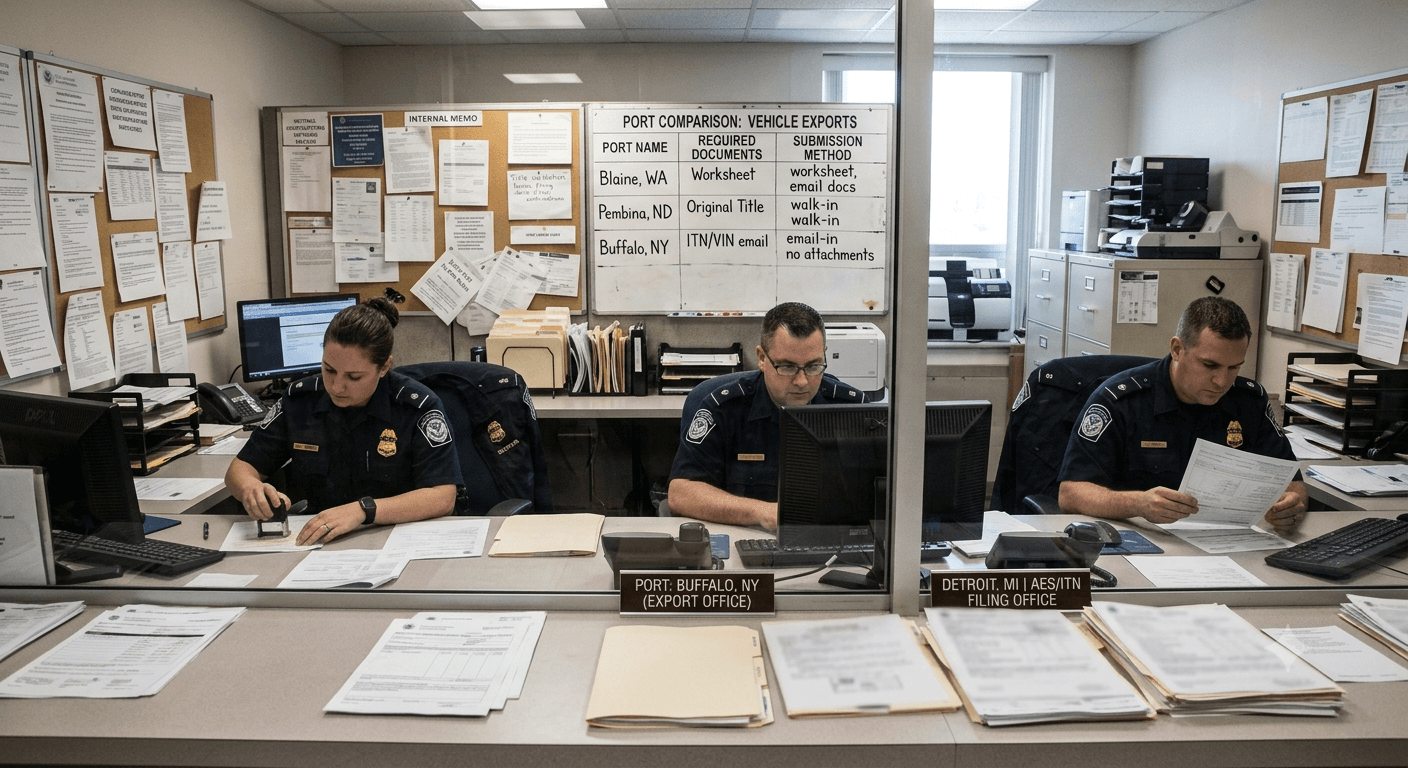
This is the part that catches people off guard. There’s no single, uniform “vehicle export process” at the border. Each port sets its own submission method, required documents, and processing style.
Blaine, WA, for example, requires exporters to complete a Vehicle Export Worksheet and email it — along with the front and back of the title and a bill of sale — to the port’s export office before arrival. Pembina, ND, on the other hand, keeps it simple: file your export information, then show up with the original title in hand.
Other ports fall somewhere in between. Buffalo, NY wants the ITN and VIN emailed directly to its office with no attachments. Detroit, MI asks for the vehicle description, VIN, and ITN emailed to a dedicated export address. Alexandria Bay, NY requires similar documentation sent ahead of time as well. The common thread across nearly all of them: documentation must be submitted at least 72 hours before the vehicle arrives at the border. Walking up with no advance notice, even with a perfectly valid title, can get your export turned away.
This is exactly why so many people shipping a vehicle across the border choose to work with a company that handles this daily, rather than trying to interpret each port’s individual requirements themselves.
No, These Ports Are Not All Open 24/7
This is the answer to the question in the headline: no, vehicle export hours vary significantly by port, and most are not 24/7.
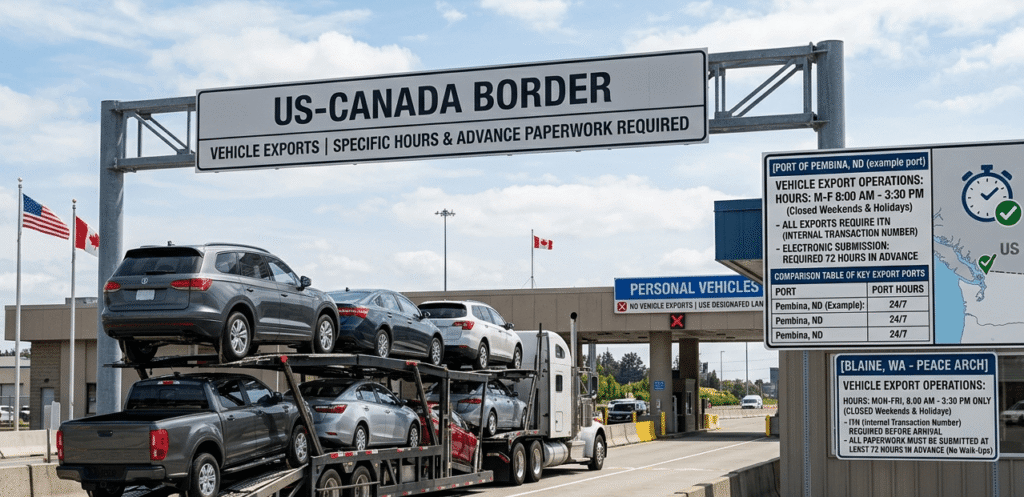
- Blaine, WA processes vehicle exports Monday through Friday, 8:00 AM to 3:30 PM only. Nights, weekends, and federal holidays are closed for exports — no exceptions.
- Pembina, ND is one of the few ports that operates as a true 24/7 export location.
- Port Huron, MI cuts off vehicle exports at noon on Fridays, meaning a shipment that would otherwise be ready Friday afternoon has to wait until Monday.
- Detroit, MI is technically listed as a 24/7 port, but in practice, export officers aren’t always staffed and available around the clock, which can mean delays even when the port is “open.”
Multiply this kind of variation across all 11 major vehicle-export ports and it becomes clear why timing a cross-border shipment isn’t as simple as picking a crossing on a map. A vehicle that’s ready to ship on a Friday evening through one port might sail through — while the same vehicle at a different port sits until Monday morning.
The One Requirement Every Port Shares: The ITN
Regardless of which port you’re exporting through, there’s one requirement that doesn’t change: you need an Internal Transaction Number (ITN) before your vehicle can legally leave the country.
The ITN is generated when you file your Electronic Export Information (EEI) through the Automated Export System (AES). CBP requires this filing for any used, self-propelled vehicle being exported — whether it’s shipped by carrier or driven across the border yourself. Without a valid ITN on file, CBP will not clear the vehicle for export, no matter how complete your other paperwork is.
Filing correctly, and filing early enough to meet each port’s advance-notice window, is one of the most common places people get stuck when trying to handle a cross-border vehicle shipment on their own.
What About the Other Major Ports?
The variation doesn’t stop with the ports above. Sweetgrass, MT and Portal, ND both serve the northern plains routes into Alberta, Saskatchewan, and Manitoba, and like most smaller ports, they expect documentation submitted well ahead of arrival rather than processed on the spot. Sault Ste. Marie, MI serves shipments heading into Ontario’s upper peninsula routes, while Champlain, NY and Houlton, ME cover the northeast corridor into Quebec and New Brunswick. Each of these ports has its own office, its own email address for export documents, and — in some cases — its own preferred format for the paperwork.
This is part of why a shipment that looks straightforward on paper (a title, a bill of sale, a truck) can stall out when the exporter hasn’t dealt with that specific port before. The people who ship vehicles across the border every week aren’t guessing at each port’s process; they already know exactly where the documents go and how far in advance they need to land.
Frequently Asked Questions
Can I show up at any US-Canada port and export my vehicle? No. Only a specific set of ports, including the ones listed above, are equipped to process vehicle exports. Showing up at a port that doesn’t handle vehicle exports means your car isn’t crossing that day.
How far in advance do I need to submit my documents? Most ports require export documentation, including your ITN, at least 72 hours before the vehicle arrives. Some ports have additional formatting or submission requirements on top of that.
What happens if I arrive outside a port’s export hours? Your vehicle simply won’t be processed. You’ll need to wait until the port reopens for exports, which at some locations means waiting through an entire weekend or holiday.
Do I need an ITN if I’m driving the vehicle across myself? Yes. The ITN requirement applies whether the vehicle is being shipped by a carrier or driven across the border personally.
Why This Matters for Planning Your Shipment
Put it all together and you get a border system where:
- Only specific ports handle vehicle exports
- Each of those ports has different submission methods and document requirements
- Export hours differ port to port, and some (like Detroit) are unreliable even when technically open 24/7
- Every single export requires a valid ITN, filed in advance
This isn’t the kind of thing you want to figure out the day you’re trying to cross. A vehicle that misses its documentation window, arrives outside export hours, or lacks a properly filed ITN can end up sitting at the border for hours — or get sent back entirely.
Let Us Handle the Border Details
At US Canada Auto Transport, we’ve been shipping vehicles across the US-Canada border since 1985. We know which ports handle exports, what each one requires, and how to time a shipment so your vehicle isn’t waiting on paperwork or port hours. Whether you’re moving a single vehicle or coordinating a fleet, we handle the ITN filing, documentation, and port-specific requirements so you don’t have to learn the fine print of 11 different customs offices.
Ready to ship a vehicle across the border? Get a free, no-obligation quote today, and let our team handle the export paperwork from start to finish.