This guide covers your options, the border rules for snowbirds, and a seven-day scenic route if you decide to drive.
Every year, thousands of Arizona to British Columbia snowbirds follow the sun between the warm deserts of the Southwest and the mild, green Pacific Northwest. Whether you’re a BC resident heading to Phoenix for the winter, or escaping Arizona’s summer heat in BC’s mountains, the trip covers about 2,200 miles (3,500 km) and an international border. You can drive it, ship your vehicle and fly, or do both: drive one way and let us ship the car or tow vehicle back.
Your options for the Arizona–British Columbia trip
1. Ship your car and fly
The simplest option. We pick your car up at your home in BC, take it across the border, and deliver it to your winter address in Arizona, usually in 4 to 8 days. You fly down and the car is waiting for you. In spring, we ship it back.
2. Drive one way, ship the car back
Enjoy the scenic drive in one direction, then fly home while we ship the vehicle. You get the road trip without facing the long, repetitive drive back down the continent, and you save the fuel, lodging and wear of a return trip.
3. Drive the RV, ship your car
Many snowbirds travel by RV and tow a small car. Shipping the car separately instead means less strain on the RV, easier driving on mountain passes, and a car waiting at your RV park when you arrive.
Whichever option you choose, book 4 to 8 weeks ahead for the fall and spring peaks. See the best time to book snowbird car shipping and our snowbird auto shipping service.
Border rules for BC snowbirds heading to Arizona
- One-year rule: US Customs allows nonresidents to bring a vehicle in duty-free for personal use for up to one year. It can’t be sold in the US and must leave within that time.
- Documents: a valid passport, driver’s license, vehicle registration, and insurance that covers you in the US. Keep the original registration or title in the glove box, plus proof that you’ll return to Canada, such as a BC property tax bill or return ticket.
- Coming home: a Canadian-registered car returning to BC isn’t an import, so there’s no duty, GST or RIV.
- Personal items: if you’re shipping the car, remove everything. Pack belongings in your RV or luggage instead.
- Border crossings: drivers taking the Okanagan route cross at Oroville–Osoyoos. Car carriers usually cross at Blaine’s Pacific Highway truck crossing.
See what US Customs requires from Canadian snowbirds, our snowbird car transport guide and the snowbird vehicle transport checklist.
Shipping a car between British Columbia and Arizona
- Pickup: anywhere in BC, from Vancouver and the Fraser Valley to the Okanagan.
- Route: carriers head south on I-5 through Washington, Oregon and California, then east to Arizona.
- Transit time: typically 4 to 8 days, depending on pickup and delivery points and the season.
- Delivery: to your home, condo or RV park in Phoenix, Mesa, Scottsdale, Tucson, Yuma or elsewhere in Arizona.
- Preparation: about a quarter tank of fuel, no personal items, and dated photos of the car before pickup.
For costs, see our snowbird auto transport cost guide. Heading to Arizona from Ontario instead? Read snowbird car shipping from Ontario to Arizona. For more on shipping from BC, see our British Columbia car shipping page and shipping a car from British Columbia to the USA.
If you drive: a 7-day Arizona to British Columbia route
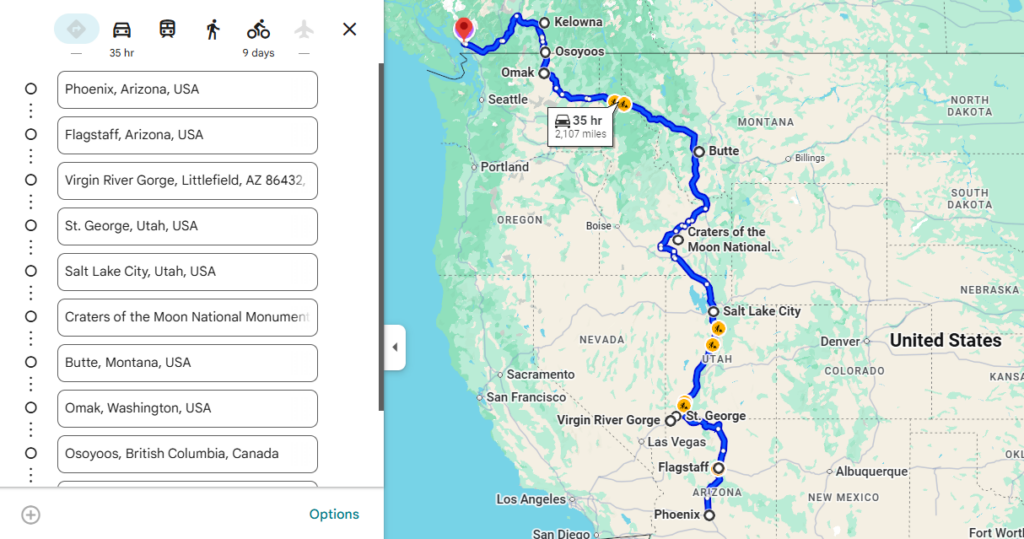
If you choose to drive at least one way, the most direct scenic route from Phoenix to Vancouver follows I-15 north, then turns west through Washington’s Okanogan Valley into BC. It passes through Arizona, Utah, Idaho, Montana, Washington and British Columbia. Budget seven days to keep driving to about 4 to 6 hours a day. The route works just as well southbound.
Days 1–2: Arizona and Utah
Leave Phoenix and climb into Northern Arizona, with a lunch stop in Flagstaff. On I-15, the Virgin River Gorge carves through dramatic canyon walls just before St. George, Utah. Overnight in Salt Lake City, between the Great Salt Lake and the Wasatch Range.
Days 3–4: Idaho and Montana
The “Big Sky” opens up. Detour to Craters of the Moon National Monument in Idaho to see its lava flows, then stop in the historic mining town of Butte, Montana, for fuel and a Pork Chop John’s sandwich.
Days 5–6: Washington and the border
Head west and follow US-97 north through Washington’s Okanogan Valley, known for its orchards and vineyards, with a stop in Omak. Cross into Canada at Oroville–Osoyoos. Osoyoos sits in Canada’s only desert.
Day 7: British Columbia
Continue past Okanagan Lake to Kelowna, then take the Coquihalla Highway (BC-5) through the mountains to Hope, a classic stop for a White Spot burger, before the final run into Vancouver. Check road conditions on the Coquihalla in winter and the shoulder seasons.
Full route: Phoenix → Flagstaff → Virgin River Gorge → Salt Lake City → Craters of the Moon → Butte → Omak → Osoyoos → Kelowna → Vancouver
Road trip tips
- Vehicle check: check tire pressure and fluid levels before you leave.
- Fuel: parts of Idaho and Montana have long stretches without services. Keep the tank above half in rural areas. In an RV, fuel will be your biggest trip cost.
- Lodging: book motels or RV parks ahead, especially in peak season.
- Insurance: confirm your policy covers you and your RV in the US.
Taking the southbound route? Consider adding a stop on Washington’s Pacific Coast for a different view of the Northwest.
Plan your snowbird season
Whether you drive, fly, or do a bit of both, getting your vehicle between British Columbia and Arizona doesn’t have to mean two long drives a year. Ship it one way or both, and spend your time enjoying the season instead of the highway.
Frequently Asked Questions
Can I drive to Arizona from British Columbia and ship my car back?
Yes. Many snowbirds drive one way and ship the vehicle for the return, then fly home. It saves days of driving, fuel, hotels and wear on the car.
How long does it take to ship a car between British Columbia and Arizona?
Typically 4 to 8 days door to door, depending on the exact pickup and delivery points and the season. Book 4 to 8 weeks ahead in peak snowbird season.
How long can my Canadian car stay in Arizona?
US Customs allows nonresidents to bring a vehicle in duty-free for personal use for up to one year. It can’t be sold in the US and must leave within that time. See what US Customs requires from Canadian snowbirds.
Do I pay duty when my car comes back to BC?
No. A Canadian-registered car returning home after a winter in Arizona isn’t an import, so there’s no duty, GST or RIV. Show your Canadian registration and ID.
Can I drive my RV and ship my car?
Yes. Many snowbirds who travel by RV ship their car separately instead of towing it, so they have a vehicle waiting when they arrive and less strain on the RV.
Can I leave personal items in a shipped car?
No. Remove all personal belongings before pickup. Pack them in your RV or luggage instead.
Which border crossing will my car use?
If you drive, the scenic route through the Okanagan crosses at Oroville–Osoyoos. Car carriers usually cross at Blaine’s Pacific Highway truck crossing, south of Vancouver.
What documents do I need?
A valid passport, driver’s license, vehicle registration, and insurance that covers you in the US. If you’re shipping the car, keep the original registration or title with the vehicle and proof that you’ll return to Canada.
Ready to Ship Your Car Between BC and Arizona?
Get a free, no-obligation quote. We’ll pick up your car in British Columbia.
We’ll handle the border crossing, and deliver it to your winter home in Arizona, then bring it back in spring.
Full Trip (Master Itinerary Link)
Phoenix → Flagstaff → Virgin River Gorge → Salt Lake City → Craters of the Moon → Butte → Omak → Osoyoos → Kelowna → Vancouver