

SEO Title: Do You Need a Registered Importer for Your Car? Meta description: Not every Canadian vehicle needs a Registered Importer to enter the US. Here’s when you need one, and why a bonded carrier is required either way.
Most vehicles built for the Canadian market are also built to comply with US safety standards. In practice, this means the majority of personal vehicle imports from Canada don’t require a Registered Importer at all. But there’s a specific set of circumstances where one becomes not just helpful, but legally required — and getting this wrong can mean your vehicle sits at the border, or worse, gets sent back.
Here’s how to know which category your vehicle falls into.
The Default: Importing Without a Registered Importer
If you’re bringing a personally owned vehicle into the US (not for resale), and the manufacturer provides a letter of compliance, most Canadian-market vehicles can be imported as a conforming vehicle under Box 2B of the HS-7 Declaration form — no Registered Importer, no modifications, no bond.
This covers the vast majority of everyday imports: a vehicle purchased in Canada, inherited from a Canadian relative, or brought down after a relocation, where the manufacturer confirms the vehicle meets US standards.
Minor Exceptions That Still Qualify Under Box 2B
Here’s where it gets more specific. A manufacturer’s letter of compliance doesn’t always say the vehicle is 100% identical to its US counterpart — and it doesn’t need to, in every case. Certain listed exceptions still allow the vehicle to be imported under Box 2B without a Registered Importer:
- Speedometer or headlight differences. If the only noted exceptions relate to the speedometer or headlights, the vehicle can still be imported as conforming under Box 2B.
- Theft Prevention Standard parts marking. If the letter notes the vehicle doesn’t comply with the parts-marking requirements under 49 CFR Part 541, it can still qualify under Box 2B — but only if the importer provides Customs with an invoice from a franchised dealer or other commercial entity confirming the required theft-prevention markings have been applied.
- Tire Pressure Monitoring Systems (FMVSS No. 138). If the exception noted is a missing or non-compliant TPMS, the vehicle can still qualify under Box 2B — but only with an invoice from a franchised dealer or authorized repair facility confirming a TPMS identical to, and using the same part numbers as, the system installed on US-market vehicles.
In each of these cases, the paperwork matters as much as the fix itself. Customs isn’t just looking for the exception to be addressed — they’re looking for documented proof from a qualified source that it was.
The One Exception That Blocks Box 2B Entirely
There’s one exception that can’t be resolved without escalating to a different import category: FMVSS No. 208, Occupant Crash Protection (automatic restraint requirements).
If the manufacturer’s letter states the vehicle complies with everything except FMVSS 208, the vehicle cannot be imported as conforming under Box 2B — period. The same applies if the manufacturer refuses to issue a compliance letter at all. In either case, the vehicle can only be imported under Box 3 of the HS-7 form, which requires a Registered Importer.
It’s worth noting that manufacturers are under no obligation to issue a compliance letter, and NHTSA has no authority to compel one. If a manufacturer won’t provide it, that decision alone routes your vehicle into Registered Importer territory.
When a Registered Importer Becomes Required
Outside of the exceptions listed above, if the compliance letter notes anything else the vehicle doesn’t meet — and the vehicle isn’t a salvage or reconstructed vehicle — it has to be imported under Box 3 through a Registered Importer (RI).
Here’s what that process typically looks like:
- The RI modifies the vehicle. This usually involves work on the vehicle’s instrument cluster and any other systems needed to bring it into full US compliance.
- The RI submits the file to NHTSA. Once the modifications are complete, the RI submits documentation to NHTSA confirming the work.
- NHTSA issues a bond release. This typically takes around 30 days from when NHTSA receives the file.
- The RI releases the vehicle for final delivery once the bond release comes through.
This isn’t a fast process, and it isn’t something you can shortcut by doing the modifications yourself. The compliance work has to go through a Registered Importer specifically, because they’re the ones bonded and authorized to certify the vehicle to NHTSA.
Why You Can’t Just Drive the Vehicle to the Registered Importer
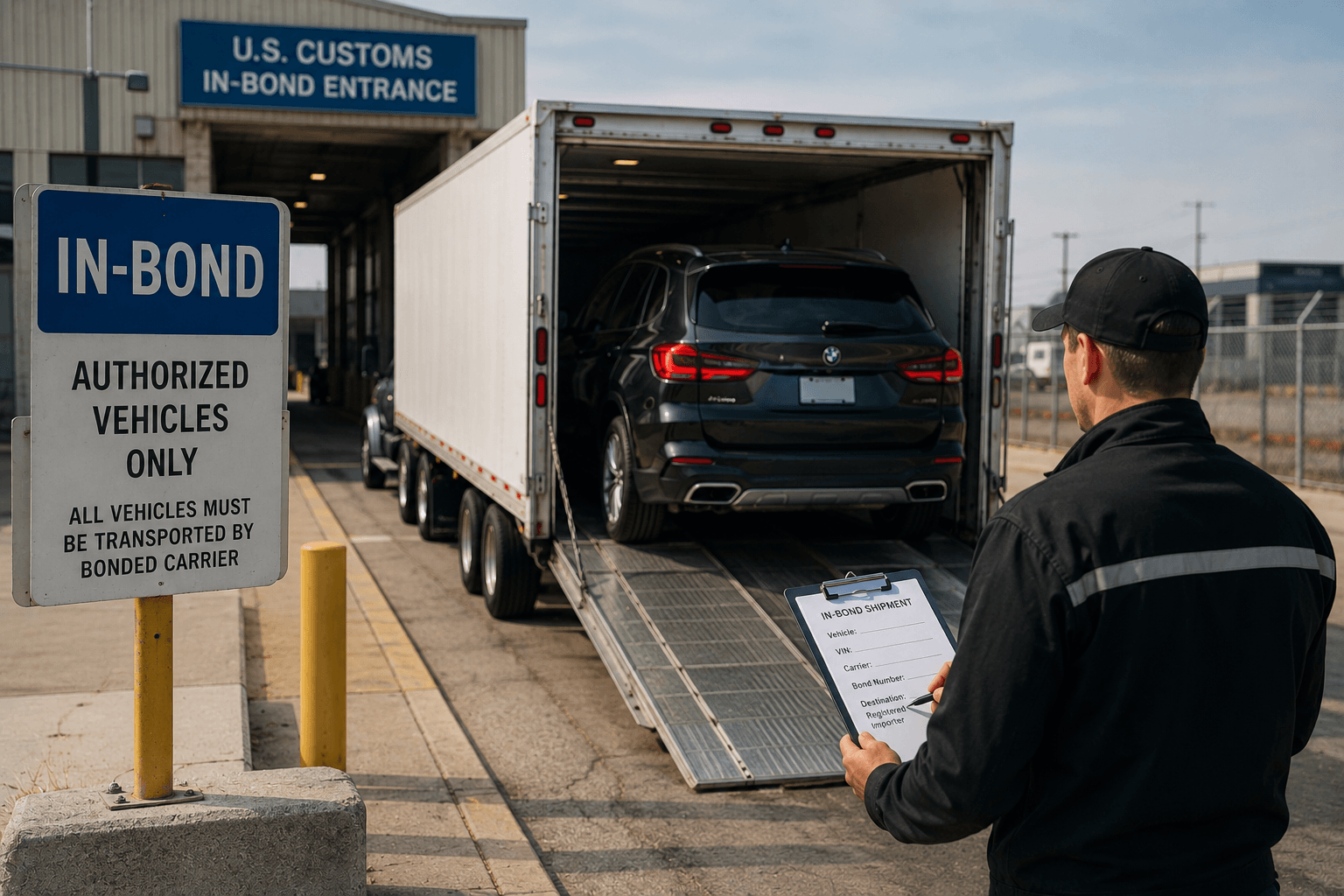
This is the detail that surprises most people: you cannot drive the vehicle to the Registered Importer’s facility yourself. A vehicle headed to an RI has to enter the US in-bond, which means it must be transported by a bonded carrier — not privately driven across the border.
That’s where a cross-border shipping company comes in. The vehicle is delivered in-bond to the Registered Importer’s lot, held there while the RI completes the required modifications and NHTSA processes the bond release, and then transported again for final delivery once that release is issued.
If the vehicle is already in the US and it turns out an RI is required, the situation isn’t much simpler — the vehicle has to be returned to Canada first (either driven back or shipped back) and then reimported correctly through the RI process.
Frequently Asked Questions
Does every Canadian vehicle need a Registered Importer to enter the US? No. Most Canadian-market vehicles are already built to US safety standards and can be imported under Box 2B with a manufacturer’s compliance letter, no Registered Importer required.
What if the manufacturer won’t provide a compliance letter at all? If a manufacturer refuses to issue a letter, or issues one that excludes FMVSS 208, the vehicle can only be imported through a Registered Importer under Box 3. NHTSA cannot compel a manufacturer to issue a compliance letter.
Can I do the required modifications myself instead of using a Registered Importer? No. Vehicles requiring modification to meet US standards must go through a Registered Importer, who is bonded and authorized to certify the work to NHTSA.
Why can’t I just drive the vehicle to the Registered Importer myself? Vehicles headed to an RI must enter the US in-bond, which requires transport by a bonded carrier. Privately driving the vehicle across the border doesn’t satisfy this requirement.
How long does the Registered Importer process usually take? After the RI submits the vehicle’s file to NHTSA, the bond release typically takes around 30 days. The vehicle can only be released for final delivery after that release is issued.
Why This Matters Before You Ship
The difference between a Box 2B import and a Box 3 Registered Importer import isn’t a minor technicality — it changes your timeline, your cost, and how the vehicle physically has to move across the border. Getting the compliance letter reviewed correctly before shipping is the difference between a vehicle that clears in days and one that ends up needing to be shipped back to Canada and reimported entirely.
Let Us Handle the Logistics
At US Canada Auto Transport, we’ve been shipping vehicles across the US-Canada border since 1985, including those requiring in-bond delivery to a Registered Importer. We know how to get a vehicle to an RI’s lot correctly, and how to complete final delivery once the bond release comes through — so you’re not left guessing about how the vehicle is supposed to move at each stage.
Not sure whether your vehicle needs a Registered Importer? Get a free quote today, and we’ll help you figure out the right path before you ship.