
Importing a vehicle from the United States to Canada is a common move for buyers seeking specific models or individuals relocating across the border. However, the process is far more complex than a simple road trip. Between shifting trade policies in 2026 and strict safety standards, you must navigate a maze of federal and provincial regulations to ensure your car is legal for Canadian roads.
This guide breaks down the essential rules, costs, and compliance steps required to move your vehicle north of the 45th parallel successfully. If you are planning a move, referencing our US-Canada car import guide will help you see the bigger picture of cross-border logistics.
Which US Vehicles Are Admissible in Canada?
Not every car sold in the United States can be legally imported into Canada. Before you commit to a purchase or a move, you must verify the vehicle’s admissibility. This is primarily governed by Transport Canada and the Registrar of Imported Vehicles (RIV).
The RIV Compatibility List
The RIV maintains a comprehensive list of vehicles manufactured for the US market that are eligible for entry. Most mainstream sedans, SUVs, and trucks are admissible, but they often require specific modifications to meet Canadian Motor Vehicle Safety Standards (CMVSS).
Key Restrictions to Watch For:
- The 15-Year Rule: Vehicles older than 15 years (based on the month and year of manufacture) are generally exempt from RIV requirements and do not need to meet CMVSS.
- Modified Vehicles: If a vehicle has been heavily modified from its original factory specifications (such as raised suspensions or altered emissions systems), it may be deemed inadmissible.
- Salvage and Rebuilt Titles: While some “salvage” vehicles can be imported, they are subject to intense scrutiny and must be made “repairable” before they can be licensed.
- Non-US Market Vehicles: If a car was originally manufactured for the European or Asian market and later brought to the US, it is almost impossible to import into Canada unless it is over 15 years old.
Before you start your journey from any of the US origin state pages, always check the RIV website to ensure your specific make, model, and year are on the “green” list.
Documents and Compliance Checks to Prepare
Documentation is the foundation of a smooth border crossing. If your paperwork is incomplete, the Canada Border Services Agency (CBSA) or US Customs and Border Protection (CBP) can deny entry or seize the vehicle.
The 72-Hour Rule (US Export)
Before the car can enter Canada, it must be officially exported from the US. You are required to submit your vehicle’s title to US Customs at least 72 hours before the car arrives at the border. This allows authorities to check for liens or stolen vehicle reports.
Mandatory Paperwork:
- Original Title: You must have the original certificate of title (not a photocopy). If there is a lien on the car, you must have a formal letter from the lienholder authorizing the export.
- Bill of Sale: This must clearly state the VIN, purchase price, and the date of sale.
- Recall Clearance Letter: This is a critical document from the manufacturer stating that there are no outstanding safety recalls on the vehicle. Without this, the RIV will not issue your inspection form.
- Manufacturer’s Compliance Label: Ensure the sticker on the driver’s side door jamb is intact. It proves the car was built to US federal safety standards.
Taxes, Inspections, and Registry Steps
The true cost of importing a car is often found in the “hidden” fees that accrue once you hit the border and enter your new province.
The 2026 Tax Landscape
As of 2026, the tax structure for US-to-Canada imports has become more complex due to trade surtaxes. Here is what you can expect to pay:
- GST: A 5% Federal Goods and Services Tax is applied to the vehicle’s converted value at the border.
- CUSMA and Surtaxes: While many US-made vehicles are duty-free under the Canada-United States-Mexico Agreement, certain “US-origin” goods may currently face a 25% retaliatory surtax depending on the current trade climate. Always verify if your specific VIN qualifies for CUSMA preference.
- Excise Tax: If your vehicle has air conditioning, there is a flat $100 excise tax. “Green levies” may also apply to vehicles with high fuel consumption.
- Provincial Sales Tax (PST/HST): You don’t pay this at the border, but you will be charged when you register the vehicle in your home province.
The RIV Inspection
Within 45 days of importing (or 1 year for salvage vehicles), you must take your car to an authorized RIV inspection center (often a Canadian Tire location). They will verify:
- Daytime Running Lights: Must be functional and automatic.
- Metric Speedometer: While digital displays are now common, older analog dials may need metric scale stickers.
- Child Tether Anchors: Required for passenger vehicles.
- French Labeling: Some components, like airbag warning signs, may require bilingual labels.
How Long the Import Process Usually Takes
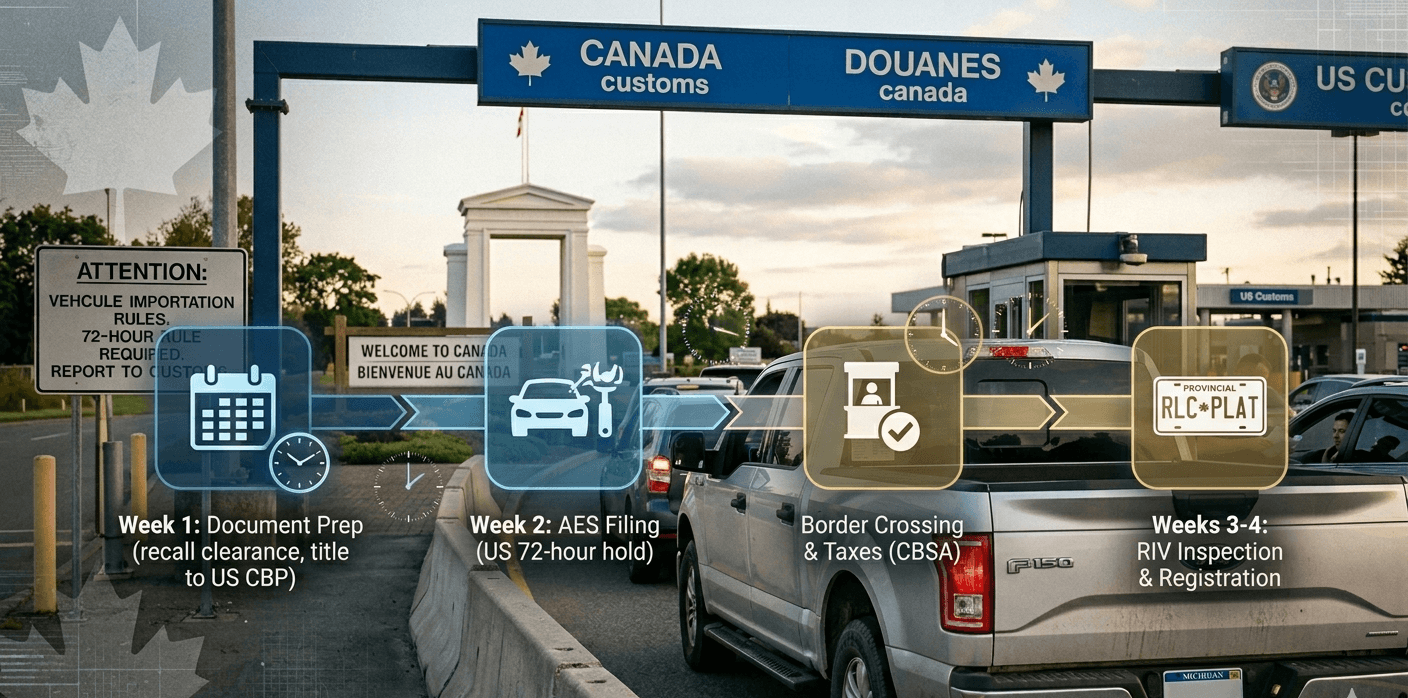
While the physical act of driving across the border takes minutes, the administrative process takes weeks.
- Pre-Border (1–2 Weeks): This involves gathering the recall clearance letter, verifying admissibility, and submitting your title to US Customs 72 hours in advance.
- At the Border (1–3 Hours): Depending on traffic and the complexity of your tax calculation (especially with current surtaxes), expect a brief stay at the CBSA office.
- Post-Border (10–14 Days): Once you pay your RIV fee online, it usually takes a few business days to receive your Form 2 (Inspection Form).
- Finalization (1–2 Days): After passing the RIV inspection, you can immediately go to a provincial licensing office to get your Canadian plates.
Total timeline: Budget for three to four weeks from the moment you decide to ship to the moment you have Canadian plates.
Common Mistakes US Sellers and Buyers Make
Experience shows that most delays are avoidable. Avoid these frequent pitfalls:
- Ignoring the Surtax: Many buyers assume “Duty-Free” means “Tax-Free.” In the 2026 trade environment, failing to account for a potential 25% surtax can turn a “great deal” into a financial burden.
- Incomplete Recall Data: Don’t rely on a verbal “it’s all good” from a seller. Get the official printout from a dealer’s database or the manufacturer’s head office.
- Missing the 72-Hour Window: If you show up at the US exit point without having filed your AES (Automated Export System) paperwork 72 hours prior, you will be turned back.
- Cleaning the Underside: Canada has strict soil and pest controls. If your vehicle’s undercarriage is caked in mud or organic matter, the Canadian Food Inspection Agency (CFIA) may order a professional cleaning at your expense before entry.
To avoid these headaches, many choose to get a cross-border car shipping quote to have professionals handle the transport and documentation.
Ready to bring your vehicle home?
Navigating the 2026 import rules requires precision and timing. Let us handle the logistics so you don’t have to worry about border delays or paperwork errors. Let US Canada Auto Transport simplify your cross-border move.
Frequently Asked Questions
1. Can I import a car that is still under a US lease or loan? Only if the finance company provides a formal, notarized letter of permission. Most US lenders do not allow their collateral to be permanently exported to another country.
2. Are electric vehicles (EVs) treated differently? As of 2026, personal imports of US-made EVs generally follow the same rules, but be aware of specific surtaxes on EVs originating from certain overseas markets (like China) that may have been sold in the US.
3. Do I have to pay duty if I am moving to Canada as a permanent resident? If you are “landing” as a new immigrant or a returning resident who has lived abroad for at least a year, you may be eligible for a personal effects exemption, though RIV fees and safety compliance still apply.
4. What happens if my car fails the RIV inspection? You have 45 days to fix the issues. If the vehicle cannot be modified to meet Canadian standards, it must be exported back to the US or destroyed under CBSA supervision.
5. Is the RIV fee the same for all vehicles? The RIV registration fee is generally a flat rate (plus applicable taxes), currently around $325–$350 CAD, regardless of the vehicle’s value.
6. Do I need a Canadian insurance policy before I cross? You must ensure your US insurance covers you for the transit, but you will need a Canadian policy to register the car provincially once you arrive.