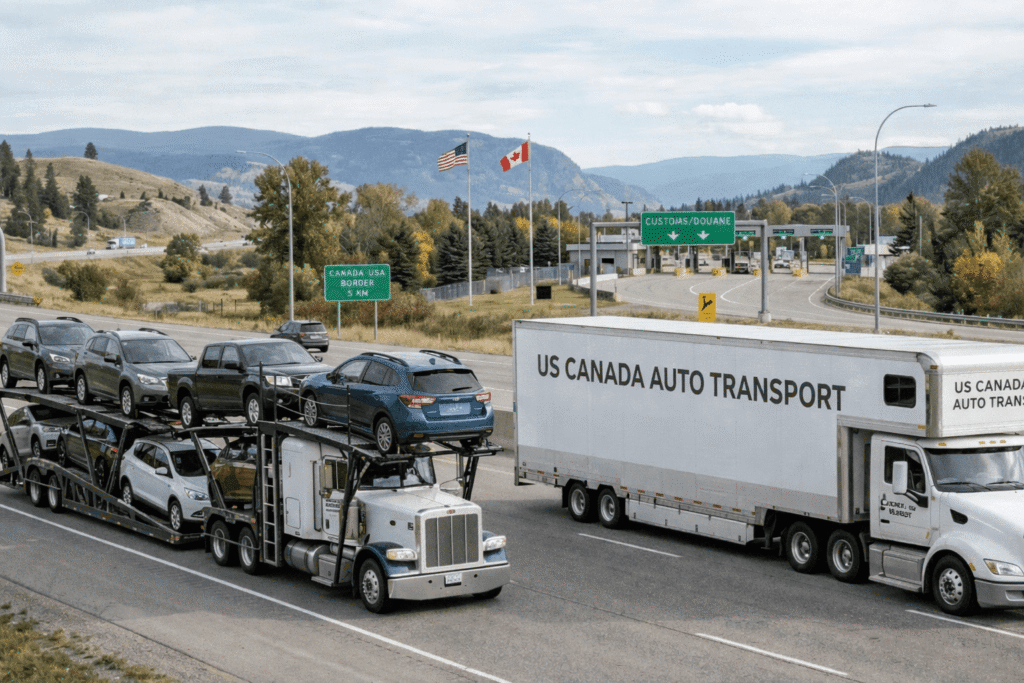
When you’re moving your vehicle between the United States and Canada, choosing between open and enclosed transport can dramatically affect both your budget and your peace of mind. Open trailers expose your car to the elements while enclosed trailers keep it fully protected inside a sealed trailer. The right choice depends on your vehicle, route, timeline, and how much protection you need.
Cross-border moves add unique variables—long hauls through varying weather, border delays, and seasonal road conditions—so understanding the real cost difference is essential. This article breaks down exactly what each method includes, how much extra enclosed shipping usually adds, and when the premium actually pays off. You’ll finish knowing precisely how to decide for your situation and where to get accurate pricing. For a complete overview of all cross-border pricing factors, see our US-Canada car shipping cost guide.
What open and enclosed transport each include
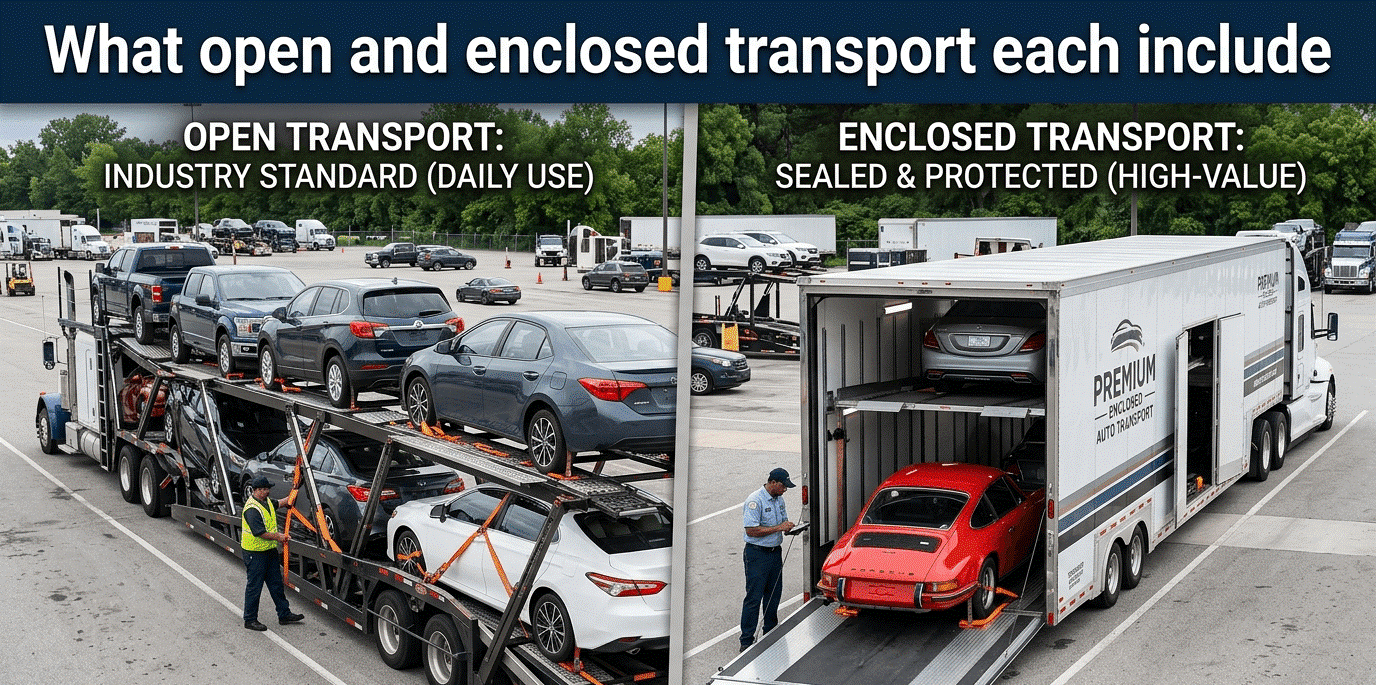
Open transport is the industry standard for most everyday vehicles. Your car rides on a multi-level open trailer that can carry up to nine vehicles at once. Professional drivers secure it with heavy-duty straps and wheel chocks, and the trailer itself is designed for highway stability. You get door-to-door or terminal-to-terminal service, full tracking, and standard cargo insurance. The entire process is fast because carriers are plentiful and routes are frequent.
Enclosed transport places your vehicle inside a fully sealed trailer, usually holding only four to six cars. The same secure strapping and chocking apply, but the trailer walls and roof shield your car from rain, snow, road salt, dust, UV rays, and flying debris. Drivers often provide extra handling care because the cargo is higher-value. Enclosed service still offers door-to-door options and the same insurance minimums, though many carriers let you upgrade coverage easily.
Both methods require you to prepare your car the same way: remove personal items, fill the gas tank to one-quarter, ensure the battery is charged, and note any pre-existing damage on the bill of lading. The practical difference comes down to exposure versus protection. Open transport is efficient and widely available; enclosed transport trades speed and capacity for complete shielding.
How much enclosed shipping usually adds
Enclosed transport typically costs 30 to 60 percent more than open transport for Canada-US routes. The exact premium depends on distance, season, and current carrier availability, but the gap is consistent across the industry.
For a short cross-border hop—say, Seattle to Vancouver or Detroit to Toronto—expect open transport to run $800–$1,400 USD for a standard sedan. The same route in an enclosed trailer usually lands between $1,200 and $2,100, adding roughly $400–$700. On longer hauls, such as Miami to Calgary or Los Angeles to Montreal (1,500+ miles), open shipping might total $1,400–$2,200 while enclosed climbs to $2,100–$3,500, adding $700–$1,300.
These figures assume operable vehicles and standard door-to-door service. Peak winter months in Canada can widen the gap another 10–15 percent because enclosed trailers stay in higher demand for weather protection. Fuel surcharges and border wait times affect both options equally, so the percentage premium remains steady.
A quick tip: always request quotes for both trailer types on the exact same dates and locations. Real-time market conditions can shrink the difference to 25 percent on popular lanes or push it toward 70 percent when enclosed carriers are scarce.
For a complete overview, check our shipping method guides.
Enclosed transport makes financial sense
Enclosed shipping makes financial sense when the cost of potential damage on an open trailer exceeds the premium you pay. That calculation is straightforward once you consider your vehicle’s value and the route.
Choose enclosed if your car is worth more than $50,000, is a classic or collector model, or has a fresh paint job or custom wrap. New or leased vehicles with strict return conditions also benefit—dealers and lessors often require proof of zero road debris exposure. Low-clearance sports cars or vehicles with soft tops and convertible roofs face higher risk of scratches or water intrusion on open trailers.
Harsh-weather corridors matter too. Driving through Canadian winters or the salty roads of the Northeast can leave pitting or corrosion on exposed paint. If your move coincides with snow, heavy rain, or construction seasons, the enclosed premium often pays for itself in avoided detailing or repair bills.
Practical insight: run the numbers yourself. A single deep scratch or rock chip on a luxury hood can cost $800–$2,000 to fix. If the enclosed upgrade adds only $600, you come out ahead. For standard daily drivers under $30,000 with no cosmetic concerns, open transport almost always wins on value.
How vehicle type changes the price gap
Vehicle type influences both the base rate and the size of the open-to-enclosed premium. Sedans and compact SUVs sit at the low end of the cost spectrum and see the smallest percentage jump—often 30–40 percent. Their lower height and weight fit easily on both trailer styles, keeping carrier options plentiful.
Larger trucks, full-size SUVs, and lifted vehicles push the base price higher because they take up more trailer space and may require specialized ramps. The enclosed premium can stretch to 50–60 percent simply because fewer enclosed trailers can accommodate oversized loads. Convertibles, exotics, and low-riders almost always trigger a bigger absolute gap because carriers charge extra handling fees and may limit open-trailer availability to protect soft tops or delicate undercarriages.
Modified cars with aftermarket wheels or spoilers can add $200–$500 to either option if extra tie-downs or measurements are needed. Electric vehicles with sensitive battery packs or large glass roofs sometimes see carriers recommend enclosed service outright, widening the gap further.
Tip: measure your vehicle’s exact height, length, and ground clearance before getting a cross-border car shipping quote. Accurate dimensions prevent surprise upcharges and help you compare apples-to-apples pricing.
Questions to ask before choosing a trailer type
Before you commit, ask these five targeted questions to any carrier:
- What is the exact premium for enclosed transport on my specific route and dates?
- How many years of experience does the driver have with cross-border moves, and what is their border crossing success rate?
- What insurance limits apply to each trailer type, and can I purchase additional coverage on the spot?
- Will my vehicle’s dimensions or condition require any special loading equipment?
- What is the current estimated transit time for each option, including typical border delays?
Write the answers down and compare them side by side. A carrier that answers clearly and offers both options without pressure is usually the most reliable. This step takes only minutes but prevents 90 percent of surprises.
Ready to see exact pricing for your move? Llet the experts at US Canada Auto Transport handle the details with transparent options for both trailer types.
FAQs
Is open transport safe for Canada-US moves? Yes. Reputable carriers secure every vehicle with multiple straps and perform pre- and post-loading inspections. Millions of cars ship open across the border every year with no issues. Minor road dirt or dust is normal and washes off easily.
How much more does enclosed transport usually cost? Plan on 30–60 percent above open rates. On a typical 1,000-mile cross-border route, that translates to an extra $500–$1,200 depending on your vehicle and season.
When should I definitely choose enclosed shipping? Choose enclosed for classics, exotics, new luxury cars, convertibles, or any vehicle you plan to show or sell immediately after delivery. It is also smart for winter moves through snowy provinces.
Does my vehicle type affect the price difference? Absolutely. Sedans see the smallest gap; trucks, lifted SUVs, and low-clearance sports cars see larger absolute and percentage increases because of space and handling requirements.
Can I change my mind after booking? Most carriers allow an upgrade to enclosed if space is still available, though you may pay a change fee. Booking both options early gives you flexibility.
How do I prepare my car for either option? Clean the exterior and interior, remove all personal belongings, fill the tank to one-quarter, disable the alarm, and document existing damage with photos. These steps are identical for open and enclosed transport.
Choosing between open and enclosed transport ultimately comes down to balancing your budget against the protection your specific vehicle and route require. With the details above, you can make an informed decision that protects both your wallet and your car.