
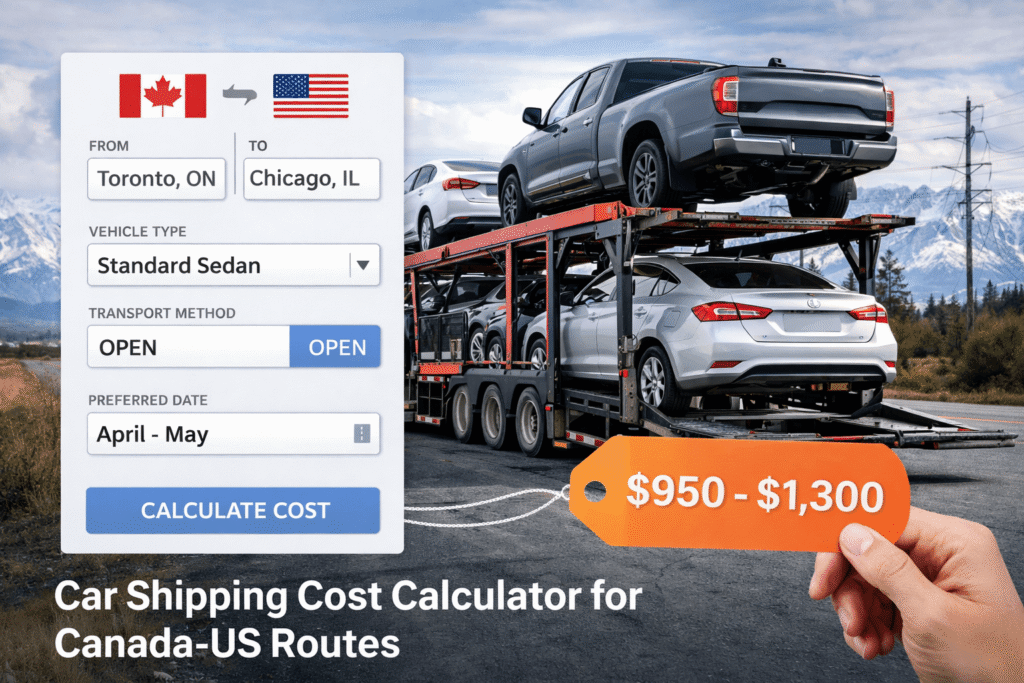
Shipping a car across the Canada-US border can feel overwhelming when you first start comparing quotes. Costs vary widely depending on your specific route, the time of year, and how you want your vehicle transported. This guide acts as your personal car shipping cost calculator for Canada-US routes. It walks you through the key variables so you can build a realistic estimate before you request a quote.
By understanding these inputs, you avoid sticker shock and make smarter decisions. Whether you are moving your daily driver from Toronto to Chicago or relocating a classic from California to British Columbia, the numbers below will help you plan confidently. For a broader overview of what drives pricing, check out our US-Canada car shipping cost guide.
The biggest inputs in a Canada-US shipping quote
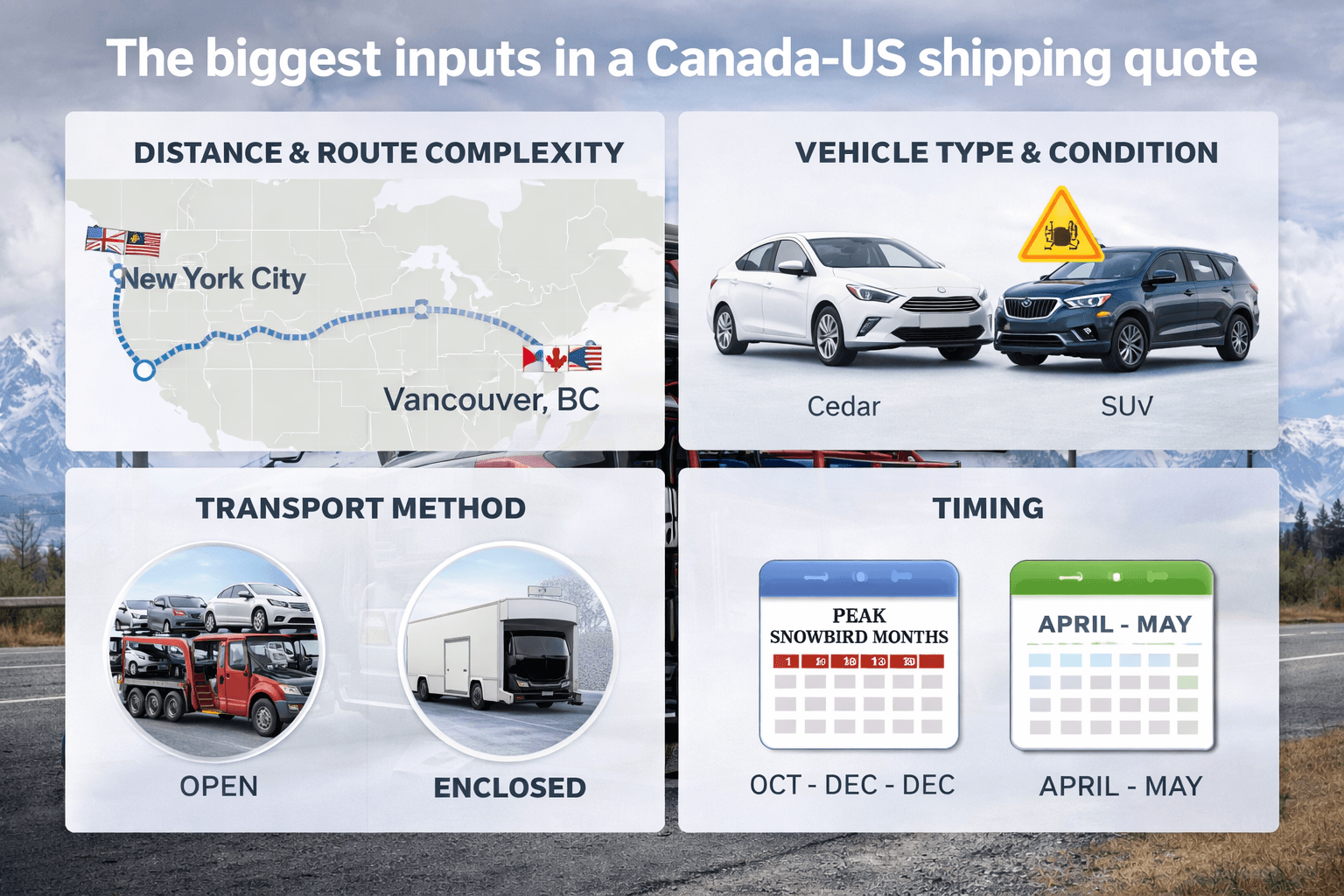
Four main factors determine what you will pay: distance and route complexity, vehicle type and condition, transport method (open or enclosed), and timing. Pickup and delivery locations also matter—door-to-door service usually costs more than terminal-to-terminal but saves you time and hassle.
Vehicle size and weight play a big role too. A compact sedan is cheaper to ship than a full-size SUV or pickup because it takes up less space on the carrier. If your car is inoperable, expect an extra fee for loading equipment. Condition matters as well; transporters inspect for leaks or damage before loading, and any issues could require extra preparation on your end.
Location specifics add another layer. Shipping from a major city like Detroit to Windsor is straightforward with multiple border options. Rural pickups in the Prairies or delivery to a remote town in the Maritimes often require additional mileage and coordination. These variables combine to create your personalized estimate—plug them into any online calculator and you will see how small changes shift the total.
How distance and route complexity affect the estimate
Distance remains the single biggest driver of cost, but it does not scale in a straight line. Short hauls under 500 miles (think Seattle to Vancouver or Buffalo to Toronto) typically run $650–$950 for open transport. Per-mile rates stay higher here because carriers must cover fixed costs like fuel, insurance, and driver time for a smaller trip.
Medium routes of 500–1,500 miles (Miami to Montreal or Denver to Calgary) drop to roughly $0.85–$1.30 per mile, landing most quotes between $800 and $1,400. Long hauls beyond 1,500 miles—such as Los Angeles to Toronto or Houston to Edmonton—offer the best value at $0.60–$1.00 per mile, with totals often falling between $1,200 and $2,000.
Route complexity adds its own premium. Every Canada-US crossing involves customs paperwork, but experienced transporters handle the CBSA and CBP declarations for you. Still, certain corridors see more traffic and occasional delays. Popular snowbird routes from Florida or Arizona to Ontario or Alberta can carry seasonal surcharges. Ferry-dependent deliveries (for example, to Vancouver Island or Newfoundland) require extra coordination and may add $200–$400.
Practical tip: Measure your exact driving distance using major highways rather than straight-line maps. Factor in any tolls or seasonal road restrictions your carrier might encounter. Booking a route that follows high-volume corridors usually keeps costs lower because carriers already run regular trucks there.
Open vs enclosed transport pricing differences
Most people choose open transport for everyday vehicles. Your car rides on an open trailer alongside five to nine other vehicles. This method keeps costs down—typically 30–60 percent less than enclosed service. It works well for standard sedans, SUVs, and trucks that already handle highway exposure daily.
Enclosed transport places your vehicle inside a fully covered trailer, protecting it from road debris, weather, and prying eyes. The premium makes sense for luxury cars, classics, or vehicles with custom paint and low mileage. Expect to pay $1,400–$2,500 for a 1,000-mile enclosed shipment compared with $900–$1,400 for the same distance on an open carrier.
The price gap widens on longer routes because enclosed trailers carry fewer vehicles and require more specialized drivers. Availability can also be tighter, so you may need to book further in advance. If your car is under warranty or you simply want maximum peace of mind, the extra cost often pays for itself in reduced risk.
Tip: Ask yourself whether your vehicle will suffer from two to seven days outdoors. For most modern cars, open transport is perfectly safe and far more affordable. Reserve enclosed for high-value or sentimental rides.
Practical tip: Measure your exact route mileage and note any seasonal travel restrictions in border states or provinces before you get a cross-border car shipping quote.
Seasonality, snowbird demand, and border delays
Timing can swing your quote by hundreds of dollars. Peak seasons drive up demand and reduce carrier availability. Summer months (June through August) see heavy relocation traffic as families move for jobs or school. Winter brings the snowbird rush—Canadians heading south to Florida, Arizona, and Texas from October to March, then returning north in spring. Southbound winter rates often rise 15–25 percent during those months.
Weather adds another variable. Snow and ice on northern routes can slow carriers or force detours, while hurricanes in the south occasionally reroute shipments. Border delays are usually minimal for professional transporters because they file all paperwork electronically in advance. Still, high-volume holidays or sudden policy changes can add one to two days at busy crossings like Detroit-Windsor or Blaine, Washington.
Practical insight: Shoulder seasons (April–May and September–October) often deliver the lowest rates and fastest availability. If your schedule is flexible, shifting pickup by even two weeks can save money and reduce stress. Always confirm current border wait times with your transporter rather than relying on general apps.
For further assistance, check here for helpful car shipping route guides.
How to turn an estimate into an accurate quote
An online calculator gives you a strong ballpark figure, but only a detailed quote reflects your exact situation. Start by gathering your vehicle details (year, make, model, running condition), exact pickup and delivery addresses, and preferred dates. Upload clear photos of the car from all angles—transporters use these to confirm condition and plan loading.
Next, decide on open versus enclosed and whether you want door-to-door or terminal service. Provide any special instructions, such as removing personal belongings or noting aftermarket modifications. Reputable companies will ask these questions upfront so there are no surprises on pickup day.
Once you submit the details, expect a firm quote within minutes to a few hours. Review the included services: loading, transport, unloading, insurance, and border handling. Most carriers require a small deposit to secure your spot on the truck, with the balance due before delivery. Track your shipment via GPS updates and stay in touch with the driver for any last-minute adjustments.
Tip: Get quotes from at least two transporters to compare, but never base your decision on price alone. Verify licensing, insurance coverage (usually $100,000–$250,000 per vehicle), and reviews specific to Canada-US routes. A slightly higher quote from a company that handles cross-border paperwork daily often proves cheaper in the long run by avoiding delays.
Ready to move your vehicle across the border with confidence? US Canada Auto Transport specializes in seamless Canada-US car shipping. Request your quote today and let our team turn your estimate into a smooth, worry-free delivery.
Frequently Asked Questions
1. What is the typical cost to ship a car between the US and Canada? Most standard sedans ship for $800–$2,500 depending on distance and season. Short routes under 500 miles often land under $1,000, while coast-to-coast equivalents exceed $1,800. Enclosed service adds 30–60 percent to these figures.
2. How long does cross-border car shipping usually take? Expect 2–7 business days for most routes. Short border hops can finish in 1–3 days; longer hauls take 5–10 days. Weather, border volume, and your chosen dates influence the exact timeline.
3. Do I need any special documents to ship my car across the border? You provide proof of ownership, ID, and any required export declaration. Professional transporters handle the rest—customs forms, temporary import permits, and duty calculations if applicable. They walk you through exactly what is needed so you avoid surprises.
4. Is enclosed transport worth the extra money for my vehicle? It depends on value and condition. For daily drivers, open transport is safe and cost-effective. Choose enclosed for classics, exotics, or any car you want fully shielded from elements and road debris.
5. Can I ship my car in winter without major delays? Yes, but plan ahead. Winter routes may add 1–3 days due to weather, yet carriers operate year-round with proper equipment. Snowbird demand can tighten availability, so book early.
6. What is the best way to lower my Canada-US shipping cost? Ship during shoulder seasons, choose open transport for standard vehicles, use terminal service if you can drop off and pick up, and provide accurate details upfront to avoid change fees. Flexible dates also help carriers fit your vehicle onto existing runs.