Shipping a vehicle from the United States into Canada involves more than simply loading it onto a carrier and crossing the border. The export process is structured, time-sensitive, and strictly enforced by U.S. Customs and Border Protection (CBP). Understanding how it works helps you avoid delays, additional costs, and compliance issues.
This guide explains each step of the U.S. vehicle export process for Canada-bound shipments, from documentation to border procedures and carrier coordination.
When a vehicle must be formally exported from the US
Not every cross-border move requires a formal export, but most permanent vehicle shipments from the U.S. to Canada do.
You must complete the export process if:
- The vehicle is leaving the U.S. permanently
- Ownership is being transferred to a Canadian resident or business
- The vehicle will be registered in Canada
Temporary exports, such as short-term travel or tourism, do not require formal export clearance. However, once the intent shifts to permanent importation into Canada, export compliance becomes mandatory.
U.S. Customs requires advance notice and document submission before the vehicle reaches the border. This applies whether you are driving the vehicle yourself or using a professional carrier.
If you are still planning your full move, refer to our US-Canada car import guide for a broader overview of the entire process on both sides of the border.
Title, ownership, and customs notice requirements
The most critical part of the export process is proving ownership and providing advance notice to U.S. Customs.
Vehicle title requirements
You must provide a valid, original vehicle title. This document confirms legal ownership and is required for export clearance.
Key considerations:
- The title must be in your name or properly assigned to you
- If there is a lien, a lien release letter is required
- Electronic titles may need to be converted to paper titles before export
If ownership documentation is incomplete or inconsistent, the export will be denied at the border.
72-hour export notice
U.S. Customs requires that you submit export documentation at least 72 hours before the vehicle arrives at the border.
This typically includes:
- A copy of the vehicle title
- Bill of sale (if recently purchased)
- Export information filed through the Automated Export System (AES), when applicable
Each border crossing has its own procedures and submission methods. Some ports require email submission, while others use online portals.
Failure to meet the 72-hour notice requirement is one of the most common causes of delays.
Matching details
All information must match across documents:
- VIN (Vehicle Identification Number)
- Owner name
- Vehicle description
Even minor discrepancies can trigger inspection holds or rejection.
How carriers coordinate export timing
Professional carriers play a critical role in aligning logistics with customs requirements. Timing is not flexible once documentation has been submitted, so coordination must be precise.
Pickup scheduling
Your carrier will schedule pickup based on:
- When export documents are accepted by U.S. Customs
- The 72-hour waiting period
- Border crossing appointment availability
If the vehicle is picked up too early, it may arrive at the border before clearance is granted. If picked up too late, it can disrupt delivery timelines.
Route planning
Carriers select border crossings based on:
- Processing efficiency
- Export office hours
- Shipment destination in Canada
For example, high-volume crossings may offer faster processing but stricter cut-off times.
Communication
You should expect clear communication from your carrier regarding:
- Required documents
- Submission deadlines
- Estimated border crossing time
Accurate coordination ensures your shipment aligns with customs approval and avoids unnecessary storage or rescheduling fees.
What happens at the border on shipping day
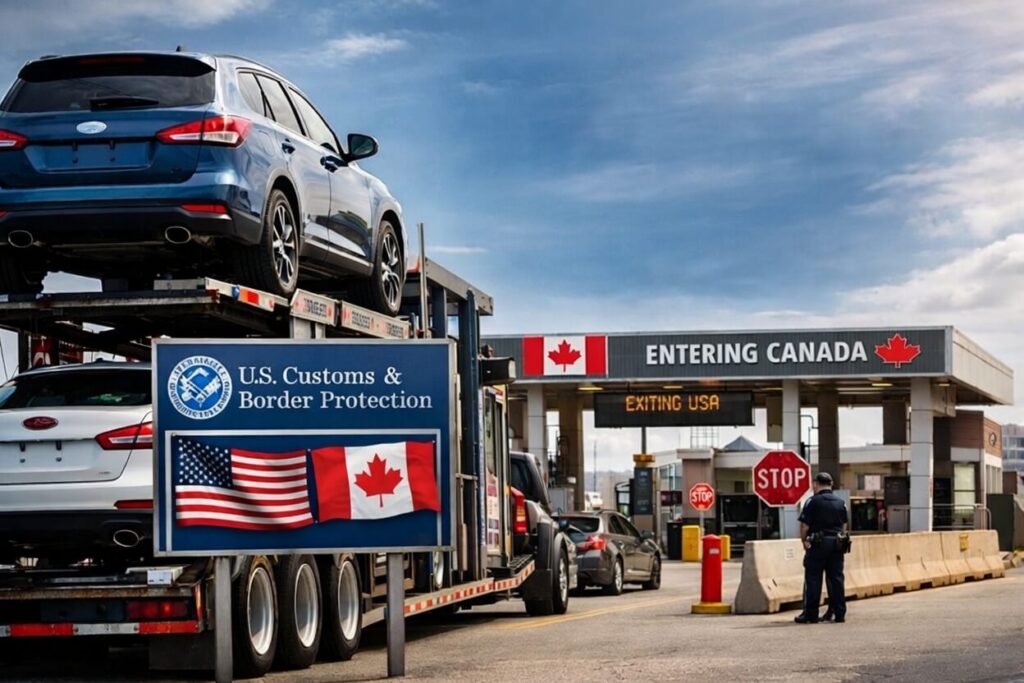
On the day of export, your carrier arrives at the designated U.S. port of export with the vehicle and all required documentation.
U.S. export clearance
U.S. Customs officers will:
- Verify submitted documents against the original title
- Check the VIN on the vehicle
- Confirm that the 72-hour notice requirement was met
If everything is in order, the vehicle is cleared for export.
If not, the vehicle may be:
- Held for further inspection
- Denied export clearance
- Required to reschedule after correcting issues
Transfer to Canadian import process
Once the vehicle exits the U.S., it immediately enters the Canadian import process.
Canadian authorities will assess:
- Vehicle admissibility
- Duties and taxes
- Compliance with Canadian standards
Your destination within Canada may influence specific requirements. You can review location-specific considerations on the Canada destination province pages.
Continued transport
After clearance, the carrier proceeds to the final destination, whether that is:
- A residential address
- A dealership
- A designated drop-off location
Mistakes that can delay a Canada-bound shipment
Even minor oversights can disrupt the export process. Avoiding common mistakes helps ensure a smooth shipment.
Missing the 72-hour window
Submitting documents late means your vehicle cannot be exported on schedule. This often results in rescheduling fees and delivery delays.
Tip: Submit documents as early as possible and confirm receipt with the export office.
Incorrect or incomplete title
Titles with errors, liens, or missing signatures will not be accepted.
Tip: Review your title carefully and resolve any issues before scheduling transport.
VIN mismatches
If the VIN on the vehicle does not match the paperwork exactly, customs will not approve the export.
Tip: Double-check all documents for accuracy, including digits and formatting.
Choosing the wrong border crossing
Not all crossings process vehicle exports, and some have limited hours.
Tip: Work with a carrier experienced in cross-border shipments to select the correct port.
Poor timing coordination
Scheduling pickup without aligning it with customs clearance can lead to storage charges or missed delivery windows.
Tip: Confirm that your carrier is coordinating directly with export requirements.
Practical tips for a smooth export process
- Start early: Begin document preparation well before your planned shipping date
- Use experienced carriers: Cross-border expertise reduces the risk of delays
- Stay organized: Keep digital and physical copies of all documents
- Confirm requirements: Each border crossing may have unique procedures
- Plan for contingencies: Weather, inspections, or processing delays can affect timelines
If you are ready to move forward, you can get a cross-border car shipping quote tailored to your route and timeline.
FAQs
1. How long does the U.S. vehicle export process take?
The minimum timeline is 72 hours due to the advance notice requirement. Including scheduling and transport, the full process typically takes several days to over a week.
2. Can a vehicle be exported without the original title?
No. U.S. Customs requires the original title or an acceptable equivalent. Without it, the vehicle cannot be cleared for export.
3. Does every border crossing handle vehicle exports?
No. Only specific ports of export process vehicle shipments. Each location has its own procedures and hours of operation.
4. What happens if the 72-hour notice is not submitted?
The vehicle will not be allowed to export. You will need to resubmit documents and wait another 72 hours before attempting again.
5. Can a shipping company handle the export process for you?
Yes. Experienced carriers coordinate documentation, scheduling, and border procedures to ensure compliance with U.S. export requirements.
6. Is the export process different for financed vehicles?
Yes. If there is a lien on the vehicle, you must provide a lien release letter from the lender. Without it, export clearance will not be granted.