Toyota & Kia Letter of Compliance: How to Import from Canada to the USA (2026 Guide)
Toyota and Kia no longer issue Letters of Compliance. Here’s what that means for your import from Canada to the USA — and exactly what to do next.
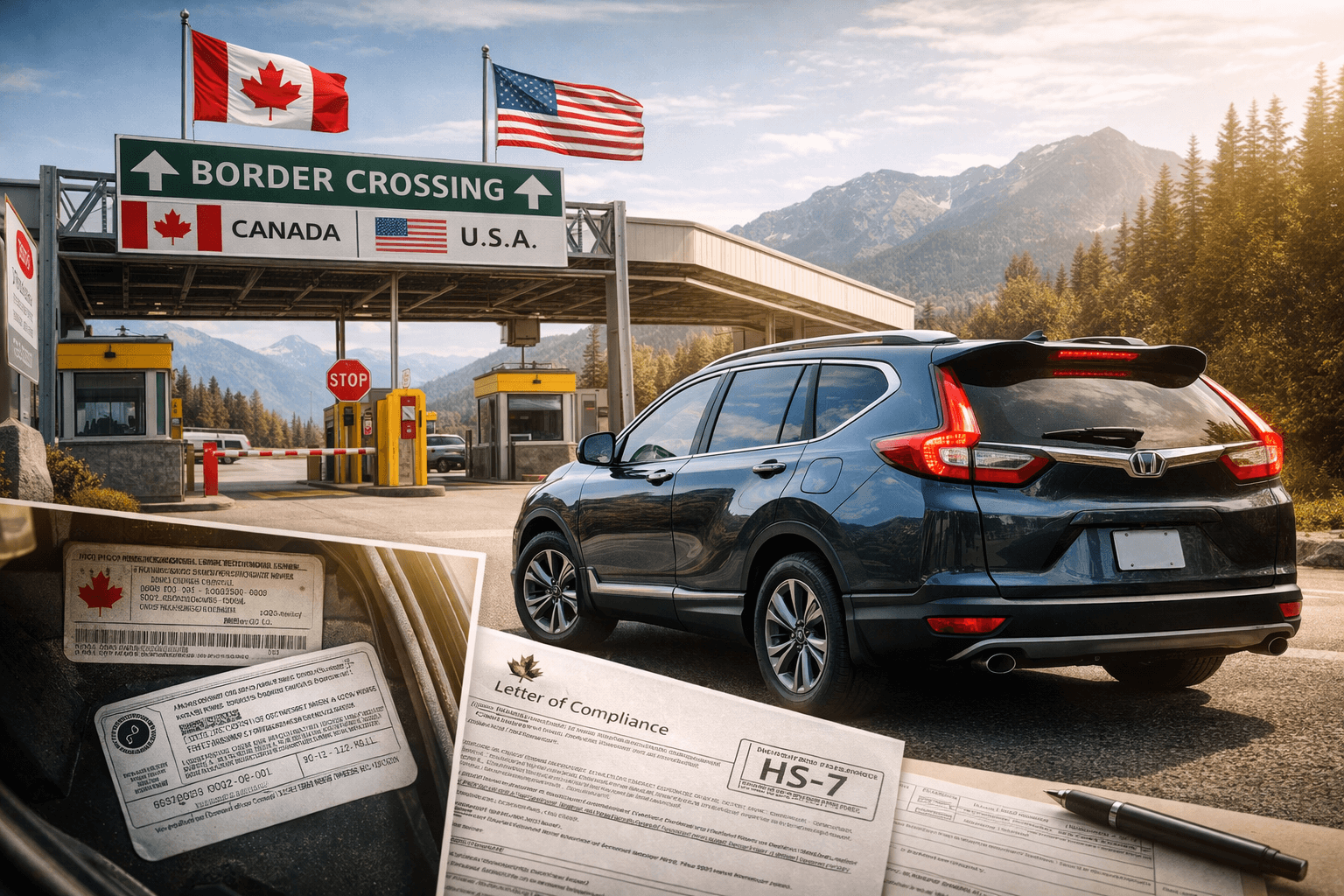
If you’re planning to import a Toyota or Kia from Canada to the United States, you’ve likely searched for a Letter of Compliance — and hit a wall. As of 2026, Toyota and Kia no longer issue Letters of Compliance to individual importers. That doesn’t mean your import is impossible. It means the path is different, and you need to understand exactly what your options are before your vehicle reaches the border.
This guide explains what compliance means, why Toyota and Kia stopped issuing letters, what you can do instead, and how US Canada Auto Transport — operating cross-border routes since 1985 — coordinates the entire process for you.
Already know your situation? Get a shipping quote here or fill out the form below and we’ll assess your vehicle’s compliance status and transport cost together.
What U.S. Compliance Actually Means
When a vehicle enters the United States from Canada, U.S. Customs and Border Protection (CBP) requires it to comply with three federal standards:
- EPA emissions standards — confirmed by an EPA label, typically found under the hood or on the engine block
- DOT Federal Motor Vehicle Safety Standards (FMVSS) — confirmed by a DOT label, typically on the driver-side door jamb
- Anti-theft requirements — established under the Motor Vehicle Theft Prevention Standard
Many vehicles manufactured in Canada and sold in the Canadian market were built to the same specifications as U.S.-market vehicles. The problem is the labels. A Canadian-market vehicle may display a Transport Canada maple leaf label confirming it meets Canadian Motor Vehicle Safety Standards — but that label alone does not satisfy U.S. Customs. The CBP officer needs U.S.-specific confirmation.
When the U.S. labels are present on the vehicle, import is straightforward. When they’re missing, you need an alternative way to prove compliance.
What a Letter of Compliance Is — and Why It Matters
A Letter of Compliance is a document issued directly by the vehicle’s manufacturer that certifies a specific vehicle, by VIN, was built to U.S. standards at the time of manufacture — even if it doesn’t carry the U.S. labels. With this letter, the importer selects Box 2B on DOT Form HS-7, which declares the vehicle complies with all applicable Federal Motor Vehicle Safety Standards.
For years, this was the standard solution for importing Canadian-market Toyotas and Kias that lacked U.S. labels. Importers would contact the manufacturer, pay a fee if required, and receive the letter in time for the border crossing.
That process no longer works for Toyota or Kia. Toyota refers to this document as a Manufacturer’s Confirmation Letter — you may see both terms used interchangeably.
Toyota & Kia No Longer Issue Letters of Compliance (2026)
Each manufacturer has always handled compliance letter requests differently. The current situation as of 2026:
| Manufacturer | Issues Letters of Compliance? |
|---|---|
| Toyota | ❌ No longer issues them |
| Kia | ❌ No longer issues them |
| Hyundai | ✅ Previously stopped; now issuing again |
| Other manufacturers | Varies — some charge fees or have strict requirements |
If you own a Toyota RAV4, Tacoma, Corolla, Camry, Highlander, or any other Toyota model purchased in Canada, you cannot get a Letter of Compliance directly from Toyota. The same applies to any Kia model. You will need to use a Registered Importer.
According to Toyota Canada, the reason they no longer issue these letters is that there are an increasing number of differences between Canadian and U.S. safety and emissions regulations, and that growing vehicle complexity makes it impossible for TCI to certify Canadian-spec vehicles as meeting U.S. standards. This is Toyota’s official position — not a temporary policy. You can read it directly on the Toyota Canada FAQ page.
Do You Need a Registered Importer? Quick Eligibility Check
Before assuming the worst, check your vehicle first. The RI path is only required if the standard compliance route is unavailable to you.
| Your Situation | What You Need |
|---|---|
| Vehicle has both a U.S. EPA label and a U.S. DOT label | ✅ No RI needed — labels confirm compliance |
| Vehicle is 25 years old or older | ✅ Generally exempt from DOT/EPA requirements |
| Vehicle is a Hyundai without U.S. labels | ✅ Contact Hyundai — they now issue compliance letters again |
| Vehicle is a Toyota or Kia without U.S. labels | ⚠️ RI required — Toyota and Kia do not issue letters |
| Other make, manufacturer refuses to issue letter | ⚠️ RI required |
| Vehicle is on the NHTSA Inadmissible Vehicles List | ❌ Cannot be imported into the U.S. at all |
Not sure which category your vehicle falls into? Fill out the form below with your vehicle year, make, and model and we’ll check it for you.
Using a Registered Importer When No Compliance Letter Is Available
A Registered Importer (RI) is a company officially approved by the U.S. Department of Transportation to inspect, certify, and modify imported vehicles that don’t have U.S. compliance labels. Using an RI is the legally recognized alternative when a manufacturer will not issue a Letter of Compliance.
Here’s what the RI process involves:
- Vehicle inspection — The RI physically inspects your vehicle and verifies whether it meets U.S. safety and emissions standards as-built
- Compliance verification or modification — If minor modifications are needed (such as adding U.S.-spec safety equipment), the RI performs them
- DOT compliance file preparation — The RI assembles all documentation required for DOT approval
- Mandatory 30-day holding period — Federal law requires the RI to hold the vehicle for 30 days while the compliance file is reviewed
- DOT approval and release — Once approved, the vehicle is cleared for final delivery to its U.S. destination
What does an RI cost? Registered Importer fees typically range from $1,000 to $3,000 or more depending on the vehicle, what modifications (if any) are required, and which RI facility is used. This is separate from the transport cost. We coordinate with an RI network and can give you a realistic total cost picture when you contact us.
The RI route costs more and takes longer than a standard import, but for Toyota and Kia owners without U.S. labels, it is often the only legally compliant path forward.
For a broader overview of what importing involves, see our complete guide to importing cars between the USA and Canada.
Who Makes the Final Import Decision?
The U.S. Customs and Border Protection (CBP) officer at the port of entry makes the final call on whether your vehicle is admitted. Most officers accept:
- Valid U.S. EPA and DOT compliance labels on the vehicle
- A manufacturer-issued Letter of Compliance (where available)
- A complete compliance file prepared by a Registered Importer
However, individual officers have discretion, and some apply stricter interpretations than others. If documentation is incomplete or ambiguous at the time of inspection, your vehicle may be refused entry and returned to Canada — at your expense.
This is why documentation needs to be complete and correct before your vehicle ever reaches the border. Working with a transport company that has been navigating this process since 1985 significantly reduces that risk. We review your vehicle’s compliance status before we ever load it.
How US Canada Auto Transport Handles Your Import (Step by Step)
We don’t just ship the vehicle — we coordinate the compliance side of the process so you’re not managing multiple parties on your own.
Step 1: Verify Your Vehicle’s Eligibility
We check your vehicle’s year, make, and model against the NHTSA Inadmissible Vehicle List and review its compliance label status. This determines whether you need an RI or if a simpler path is available. We also review the required customs documentation for your specific situation.
Step 2: Connect You With a Registered Importer (If Required)
If your Toyota or Kia does not have U.S. compliance labels and no manufacturer letter is available, we connect you with a DOT-approved Registered Importer from our network. We coordinate the intake process so you’re not making cold calls to RI facilities on your own.
Step 3: Transport the Vehicle to the RI Facility
We load your vehicle in Canada and transport it directly to the Registered Importer’s facility to begin the compliance process. You don’t need to arrange a separate transport leg — we handle pickup through delivery to the RI.
Step 4: 30-Day Federal Holding Period
The RI prepares your DOT compliance file and holds the vehicle for the federally mandated 30-day period. This is a legal requirement, not a processing delay — it cannot be shortened.
Step 5: Final Delivery to Your U.S. Destination
Once DOT approval is granted and the vehicle is released, we arrange final transport to wherever in the United States you need it delivered — whether that’s California, Florida, New York, Washington State, or anywhere else.
Not sure if your vehicle needs a Registered Importer?
Fill out the form below with your vehicle details. We’ll check the compliance status, explain your options, and give you a transport cost — no obligation.Get My Compliance Assessment →
Frequently Asked Questions
Can I import a Toyota Tacoma or RAV4 from Canada to the USA?
Yes — but because Toyota no longer issues Letters of Compliance, you will almost certainly need to use a Registered Importer if your vehicle doesn’t have U.S. EPA and DOT labels. The Tacoma and RAV4 are two of the most common vehicles we handle through the RI process. Contact us with your VIN and model year and we’ll confirm your specific situation.
How long does the Registered Importer process take?
The federal holding period alone is 30 days and cannot be waived. Factor in transit time to the RI facility, the RI’s own intake processing, and final delivery to your destination — and a realistic total timeline is typically 6 to 10 weeks from the date we pick up your vehicle in Canada.
How much does a Registered Importer cost?
RI fees vary depending on the vehicle, what (if any) modifications are required, and the specific RI facility. A reasonable range to budget is $1,000 to $3,000 or more for the RI’s services, which is separate from transport. We can give you a realistic combined estimate when you reach out with your vehicle details.
What if my Toyota has a Transport Canada label but no U.S. DOT label?
The Transport Canada maple leaf label confirms the vehicle meets Canadian Motor Vehicle Safety Standards — it does not satisfy U.S. Customs. Without a U.S. DOT label and without a Letter of Compliance from Toyota (which Toyota no longer issues), you will need a Registered Importer to certify the vehicle before it can enter the U.S.
What documents do I need to import my vehicle from Canada to the USA?
At minimum: the original vehicle title, your government-issued ID, EPA Form 3520-1, and DOT Form HS-7. If the vehicle is financed, you’ll also need written authorization from your lienholder. If you’re going through an RI, the RI will prepare the compliance documentation. See our customs and documents guide for the full breakdown.
Are 25-year-old vehicles exempt from compliance requirements?
Yes. Vehicles that are 25 years old or older are generally exempt from U.S. DOT and EPA import requirements, which significantly simplifies the import process. If your Toyota or Kia is a 2001 model year or older, confirm the exemption applies to your specific vehicle and situation before proceeding.
Can I drive my Canadian Toyota across the border myself instead of shipping?
You cannot drive the vehicle to the Registered Importer. It has to travel under bond from the border to the Registered Importer. Requires a bonded carrier which we are.
What is DOT Form HS-7 and which box do I check?
Box 2A is for vehicles that carry U.S. safety labels affixed by the manufacturer. Box 2B is for vehicles where the manufacturer confirms compliance via a Letter of Compliance — the path Toyota and Kia no longer support. Box 3 is for vehicles being imported through a Registered Importer. For most Toyota and Kia imports without U.S. labels, Box 3 is the correct selection.
Does US Canada Auto Transport handle the paperwork for me?
We coordinate the transport logistics and connect you with the right RI if needed. We also review your customs documentation requirements before your vehicle moves. For the complete list of what we handle vs. what you need to provide, see our customs and documents guide. For general shipping questions, our FAQ page covers transit times, payment, insurance, and more.
Why Work With US Canada Auto Transport?
We have been moving vehicles across the U.S.–Canada border since 1985. We operate our own equipment — we are not a broker handing your vehicle off to an unknown carrier. That matters when your vehicle’s import compliance is already a complicated situation that requires coordination between a Canadian pickup, a U.S. Registered Importer facility, and a final delivery destination anywhere in the country.
When you call us, you’re talking to people who have seen every compliance scenario there is and know exactly what needs to happen next. Fill out the form below to get started.